From Inner Turmoil to Social Critique: German Expressionism and the Rise of New Objectivity

The emergence of German Expressionism and its subsequent transformation into the movement known as New Objectivity represents one of the most significant artistic responses to the political and psychological upheavals of early twentieth-century Europe. These movements developed in direct dialogue with the profound cultural shifts produced by rapid industrialisation, the devastation of the First World War, and the unstable social environment of the Weimar Republic. German Expressionism sought to express inner emotional reality through distortion, colour, and psychological intensity, while New Objectivity rejected this subjectivity in favour of a detached, clinical realism that exposed the moral and political failures of post-war German society. Together, the two movements illustrate how art can function both as a powerful exploration of the inner psyche and as a sharp instrument of social critique.

The historical context surrounding the rise of German Expressionism was marked by intense political tension and cultural uncertainty within the German Empire. Under the rule of Wilhelm II, who served as German Emperor from 1888 until the collapse of the monarchy in 1918, Germany experienced rapid industrial expansion alongside growing nationalism and militarisation. Urban centres grew quickly as industrial production intensified, bringing profound social changes and widening disparities between wealth and poverty. For many intellectuals and artists, modern life appeared increasingly alienating. The pace of technological development, the spread of mass media, and the mechanisation of labour contributed to a widespread sense of disconnection and spiritual unease.
Philosophical and psychological ideas circulating at the turn of the twentieth century reinforced these feelings of cultural instability. The writings of Friedrich Nietzsche questioned traditional moral values and emphasised the importance of individual will and subjective experience. Meanwhile, the emerging field of psychoanalysis, developed by Sigmund Freud, brought new attention to the unconscious mind and the hidden emotional forces shaping human behaviour. Within this intellectual environment, artists increasingly turned inward, seeking to represent not the external appearance of the world but the emotional and psychological states that lay beneath it.
German Expressionism emerged in the early twentieth century as a radical rejection of academic realism and naturalistic representation. Instead of depicting the visible world in an objective manner, Expressionist artists aimed to communicate subjective experience. Distorted forms, exaggerated perspectives, and violent or non-naturalistic colours became essential tools for expressing emotional intensity. Painting was no longer conceived primarily as a means of recording reality; photography had already assumed that role. Instead, artists used visual distortion to convey anxiety, alienation, and the fragmented experience of modern life.
Two major artistic groups played central roles in shaping the development of German Expressionism: Der Blaue Reiter and Die Brücke. Although both groups rejected academic conventions and emphasised emotional expression, their philosophies and stylistic approaches were varied.

Der Blaue Reiter, founded in Munich in 1911 by artists including Wassily Kandinsky and Franz Marc, pursued a spiritual and symbolic approach to artistic creation. Members of the group believed that art could communicate profound spiritual truths through colour, abstraction, and symbolic imagery. Their work often explored themes drawn from nature, music, and mysticism, reflecting a belief that artistic expression could reveal a deeper harmony underlying the visible world. The group was particularly interested in the expressive power of colour and in the possibility of abstraction as a means of communicating emotional or spiritual experience.
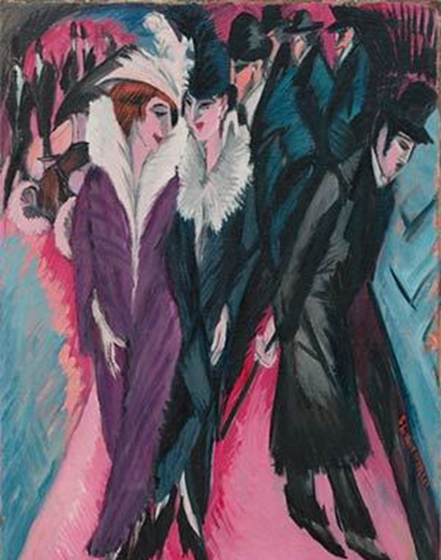
By contrast, the group known as Die Brücke, founded in Dresden in 1905 by artists such as Ernst Ludwig Kirchner and Karl Schmidt-Rottluff, adopted a more direct and visceral visual language. Their works frequently depicted scenes of urban life, social tension, and the human body rendered in aggressively distorted forms. Jagged lines, exaggerated perspectives, and intense colour palettes conveyed a sense of urgency and psychological instability. Whereas Der Blaue Reiter often explored contemplative themes associated with spirituality and abstraction, Die Brücke focused on the raw emotional experience of modern existence, particularly the alienation produced by rapidly expanding cities.

The work of the artist Marianne von Werefkin provides an illuminating example of the Expressionist interest in psychological depth and personal identity. Her painting Self-Portrait (1910) demonstrates the movement’s rejection of conventional portraiture and its emphasis on emotional intensity. In the painting, the artist confronts the viewer directly through a steady, unflinching gaze. The composition is simplified, with a dark, flattened background that isolates the figure and intensifies the psychological focus of the image. Rather than employing naturalistic modelling, Werefkin uses bold outlines and heightened colour contrasts to emphasise emotional presence over physical accuracy. The resulting image conveys an atmosphere of introspection and controlled tension. The portrait also carries a broader significance in relation to gender and artistic identity. By presenting herself as a serious intellectual figure rather than a decorative subject, Werefkin challenges traditional representations of women in art and asserts her authority as an artist.

Another work that illustrates the diversity of Expressionist experimentation is Twittering Machine (1922) by Paul Klee. Created during Klee’s association with the Bauhaus, the painting combines delicate linear drawing with subtle washes of colour to produce an atmosphere of ambiguity and quiet tension. The composition depicts four bird-like figures perched on a wire connected to a mechanical crank. The creatures appear simultaneously organic and artificial, suggesting a strange hybrid between nature and machine. The crank mechanism implies that the birds’ song might be mechanically produced rather than naturally expressed, raising questions about creativity and authenticity in a mechanised world. Rather than relying on dramatic colour contrasts or aggressive brushwork, Klee creates psychological unease through subtle visual contradictions. The painting reflects the broader Expressionist concern with alienation and the uneasy relationship between human creativity and modern technological systems.

The anxieties that permeated Expressionist art are perhaps most dramatically evident in Apocalyptic Landscape (1912) by Ludwig Meidner. In this painting, a cityscape appears to be collapsing beneath a turbulent sky filled with violent movement and explosive colour. Buildings tilt and fracture, while jagged lines and distorted perspectives create a sense of chaos and instability. The composition conveys a powerful impression of impending catastrophe. Painted shortly before the outbreak of the First World War, the work has often been interpreted as a prophetic vision of the destruction that would soon engulf Europe. The city itself becomes a metaphor for the vulnerability of modern civilisation, overwhelmed by forces that appear both natural and psychological.

Expressionist ideas extended beyond painting into other artistic media, particularly cinema. One of the most influential examples of this visual language in film is The Cabinet of Dr. Caligari (1920), directed by Robert Wiene. The film employs exaggerated architecture, sharply angled sets, and theatrical lighting to construct an environment that appears unstable and dreamlike. Streets twist unnaturally, shadows become exaggerated, and buildings lean at impossible angles. Rather than presenting a realistic setting, the film’s visual style mirrors the disturbed psychological states of its characters. This approach demonstrates how Expressionist aesthetics could translate the distortions of painting into a cinematic language capable of representing psychological experience.
The outbreak of the First World War in 1914 profoundly transformed the cultural landscape in which Expressionism had developed. At the beginning of the conflict, many Germans greeted the war with patriotic enthusiasm, believing that military victory would come quickly. Instead, the war became a prolonged and devastating struggle characterised by trench warfare, enormous casualties, and severe economic hardship. British naval blockades produced widespread shortages of food and resources, while the prolonged conflict exhausted both soldiers and civilians. By the time the war ended in 1918, Germany had suffered immense losses, and public morale had collapsed.
The end of the war triggered a political revolution that led to the abdication of Wilhelm II and the collapse of the German monarchy. In its place emerged the Weimar Republic, a democratic government established in 1919. Although the new constitution introduced progressive reforms, including expanded civil rights and universal suffrage, the republic faced enormous challenges from the beginning. The Treaty of Versailles imposed heavy reparations and strict military limitations on Germany, while territorial losses and the assignment of war guilt generated widespread resentment among the population.
Economic instability further undermined the legitimacy of the new government. In 1923 Germany experienced a catastrophic episode of hyperinflation that rendered savings worthless and destabilised the entire financial system. At the same time, millions of soldiers returned from the war physically injured or psychologically traumatised. Although the government attempted to provide assistance through disability pensions, medical care, and employment programmes, these efforts were often insufficient. Disabled veterans frequently appeared in public spaces begging for money, becoming visible reminders of the war’s human cost and of the state’s inability to address their suffering effectively.
Within this environment of social crisis and political disillusionment, many artists began to question the emotional and spiritual intensity that had characterised Expressionism before the war. The devastation of the conflict made such inward exploration seem inadequate. Instead, artists increasingly sought a new visual language capable of confronting the harsh realities of contemporary life with clarity and precision. This shift gave rise to the movement known as New Objectivity.
New Objectivity rejected the emotional excess and mystical symbolism associated with Expressionism. Instead, it adopted a sharply focused realism that emphasised precise detail and cool detachment. Artists associated with the movement often portrayed the social contradictions of the Weimar Republic with brutal honesty. Political corruption, economic inequality, and moral hypocrisy became central themes. Rather than encouraging emotional identification with their subjects, these works positioned the viewer as a critical observer.

One of the most important artists associated with New Objectivity was Otto Dix, a veteran of the First World War whose experiences at the front profoundly shaped his artistic vision. Dix’s works frequently depicted the physical and psychological consequences of warfare with uncompromising realism. In The Skat Players (1920), he portrays severely disfigured veterans gathered around a card table. Combining oil paint with collage elements, the composition emphasises the fragmentation of the human body. Prosthetic limbs, mechanical devices, and reconstructed faces create a disturbing fusion of human flesh and artificial replacement. The painting confronts viewers with the realities of wartime injury, undermining heroic narratives of military sacrifice.

Dix also explored the contradictions of Weimar society in his portraits. In Portrait of the Journalist Sylvia von Harden (Sylvia von Harden (1926)), he depicts the writer seated in a café, smoking a cigarette and wearing a monocle. The figure’s angular features, exaggerated hands, and androgynous appearance reflect contemporary debates about the emergence of the “New Woman,” a term used to describe women who pursued independence, professional careers, and social freedom during the 1920s. At the same time, Dix’s unflattering realism reveals the tensions underlying these social transformations.
Other artists associated with New Objectivity adopted an even more overtly satirical approach. The painter George Grosz produced biting caricatures of politicians, businessmen, and military figures whom he viewed as responsible for Germany’s political and moral collapse. In Pillars of Society (1926), he portrays members of the ruling elite as grotesque figures driven by greed, nationalism, and corruption. Through exaggerated forms and chaotic imagery, Grosz exposes what he saw as the hypocrisy and opportunism of those who had profited from war and economic instability.


Similarly, the work of Max Beckmann explores themes of violence, moral collapse, and existential struggle. His painting The Night (1918-19) depicts a brutal scene of domestic assault rendered in harsh angular forms and claustrophobic space. The cramped composition and distorted bodies convey an atmosphere of suffocating violence. Rather than presenting the event as an isolated incident, Beckmann’s work suggests a broader social breakdown in the aftermath of war.
Although New Objectivity rejected the emotional subjectivity of Expressionism, it did not entirely abandon its visual innovations. Distortion remained a key artistic strategy, but its function changed. Whereas Expressionist artists distorted forms to express internal emotions, artists associated with New Objectivity used distortion to expose social corruption and moral decay. The exaggerated features and unsettling realism of their works forced viewers to confront uncomfortable truths about the society in which they lived.
The transition from German Expressionism to New Objectivity therefore represents not simply a stylistic evolution but a transformation in the cultural role of art. Expressionist artists attempted to reveal the inner psychological reality of modern life, using colour, abstraction, and distortion to communicate emotional truth. In the aftermath of the First World War, however, many artists believed that such introspective exploration was no longer sufficient. The political instability and social suffering of the Weimar Republic demanded a more direct form of critique.
Through its detached realism and satirical edge, New Objectivity transformed the visual language of modern art into a powerful instrument for analysing the failures of contemporary society. Together, German Expressionism and New Objectivity demonstrate how artistic movements respond to historical crises, revealing the deep connections between visual culture, psychological experience, and political change.


Comments